From process description to optimized protocol —
in a single conversation.
Describe your system in plain language. ProcessLM builds the mechanistic model,
fits it to your experimental data, and identifies the operating conditions
that maximize your target outcome.
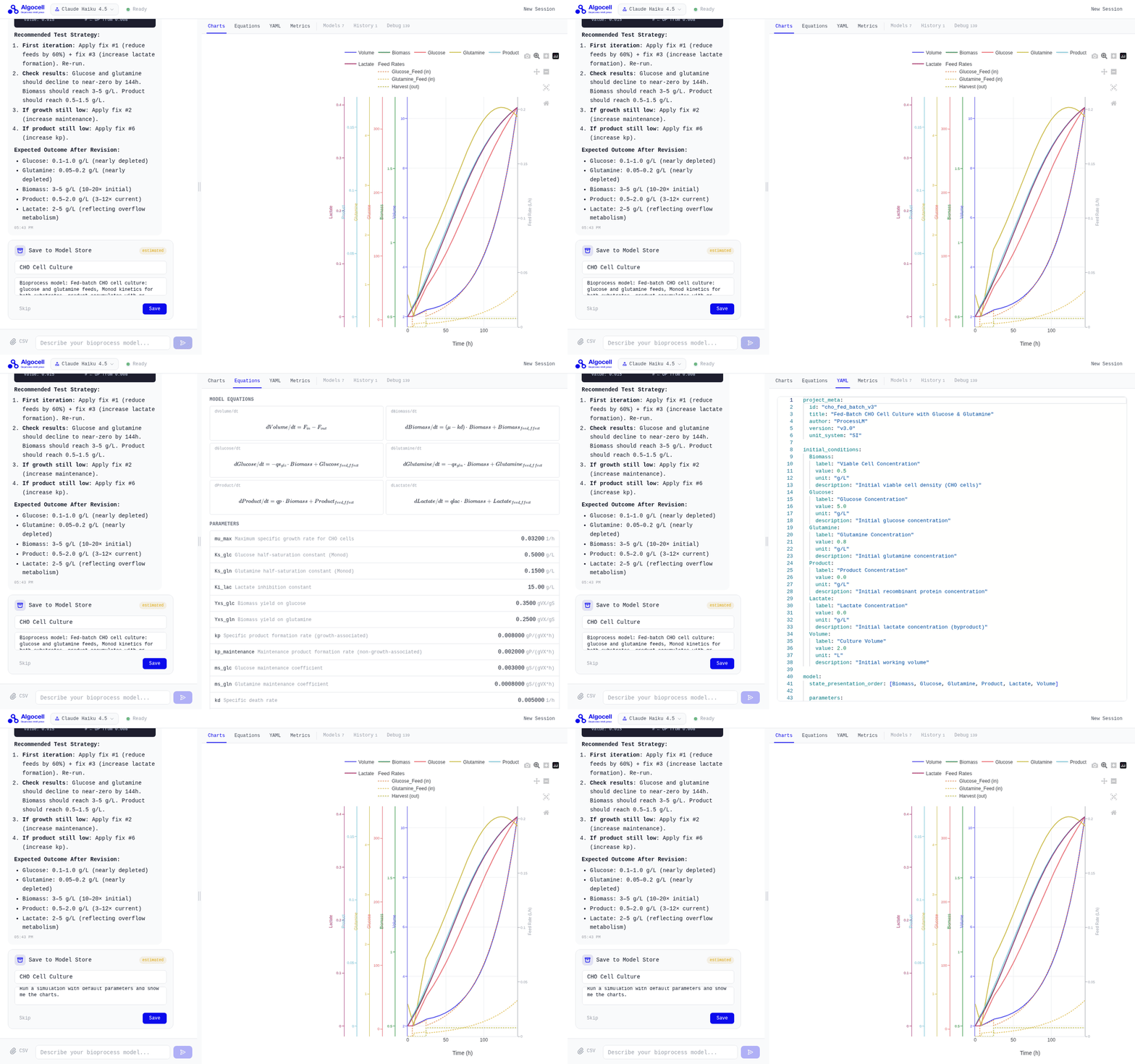
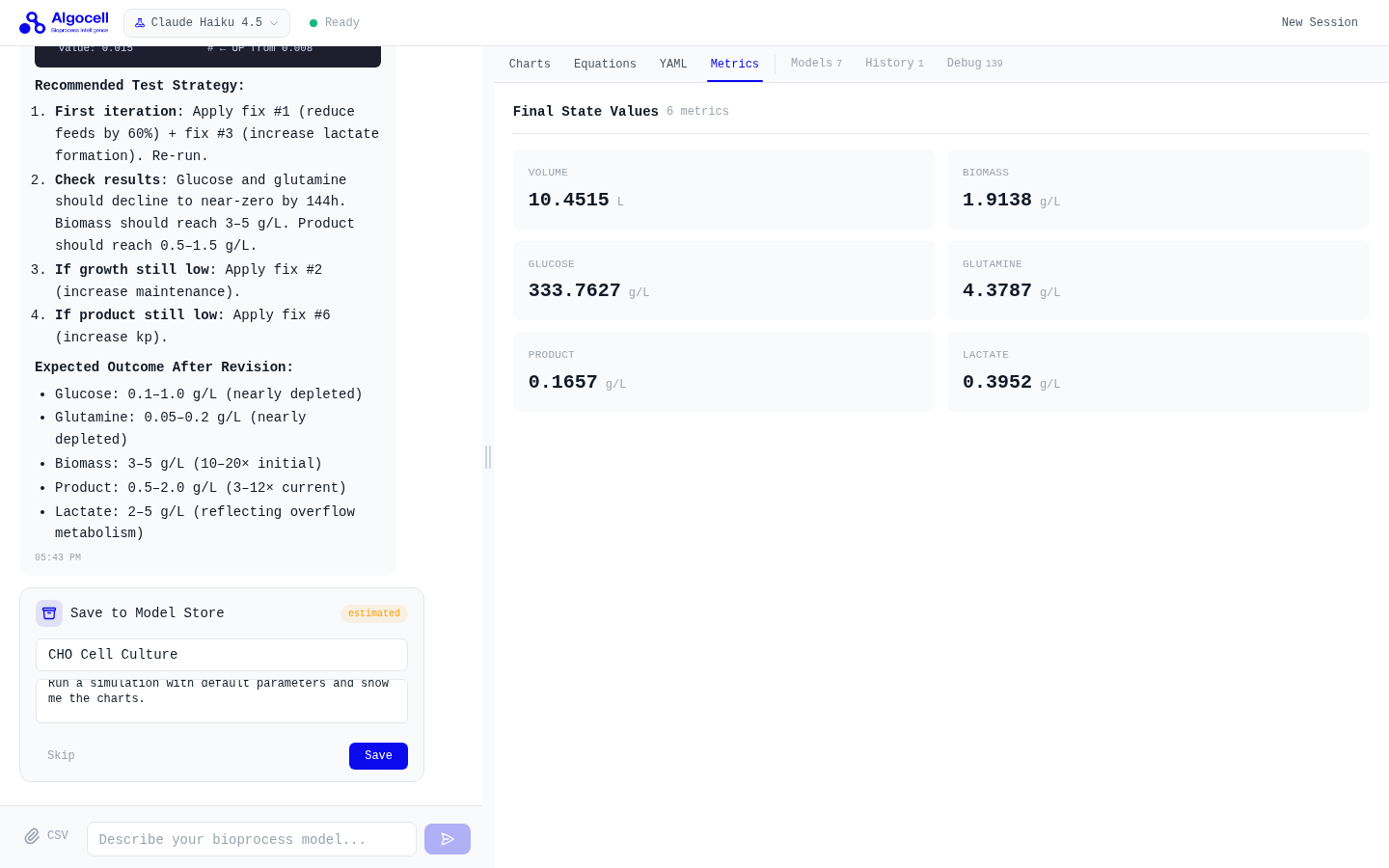
ProcessLM — CHO Cell Culture · Fed-batch simulation
How it works
Model → Calibrate → Optimize. All in one conversation.
ProcessLM collapses the design-build-test-learn loop into a conversational workflow. No modeling expertise required.
01
💬
Describe your system
Explain your process in plain language — states, inputs, known physics, and what you want to achieve.
02
🧮
Get a mechanistic model
ProcessLM generates a validated ODE model with transparent equations you can inspect, edit, and export.
03
📊
Calibrate to your data
Upload experimental measurements. The model is automatically fitted and validated against your data.
04
🎯
Optimize the protocol
Define your objective. ProcessLM finds the operating conditions that maximize your target outcome.
Product in action
Real models. Real results.
Every model ProcessLM generates is mathematically rigorous — transparent equations, validated calibration, and optimizable protocol. Here's what a CHO cell culture session looks like.
Simulation results — multi-state trajectories with Plotly charts
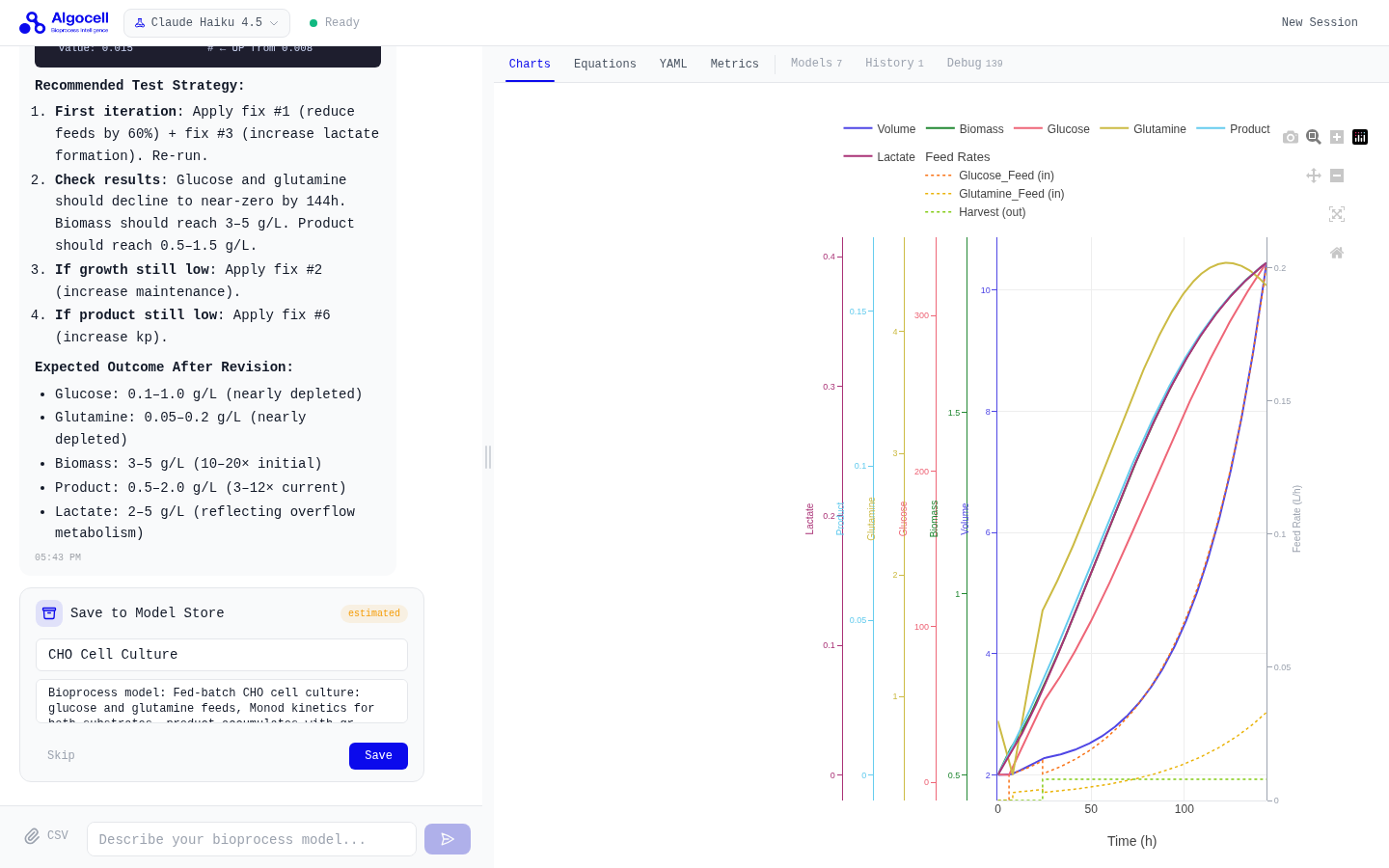
Transparent equations — every ODE rendered in full, editable at any time
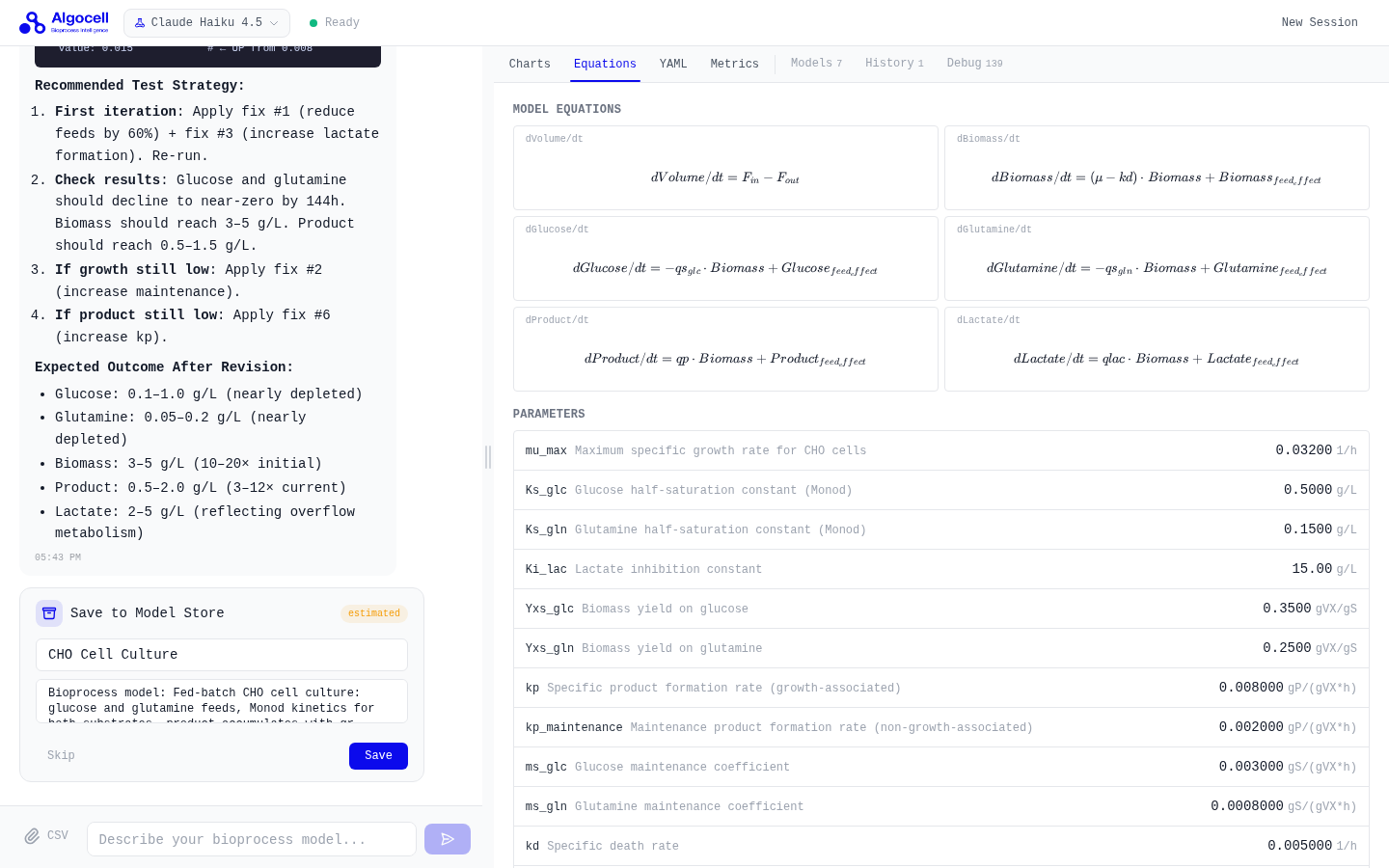
Exportable YAML — structured model definition you can version and share
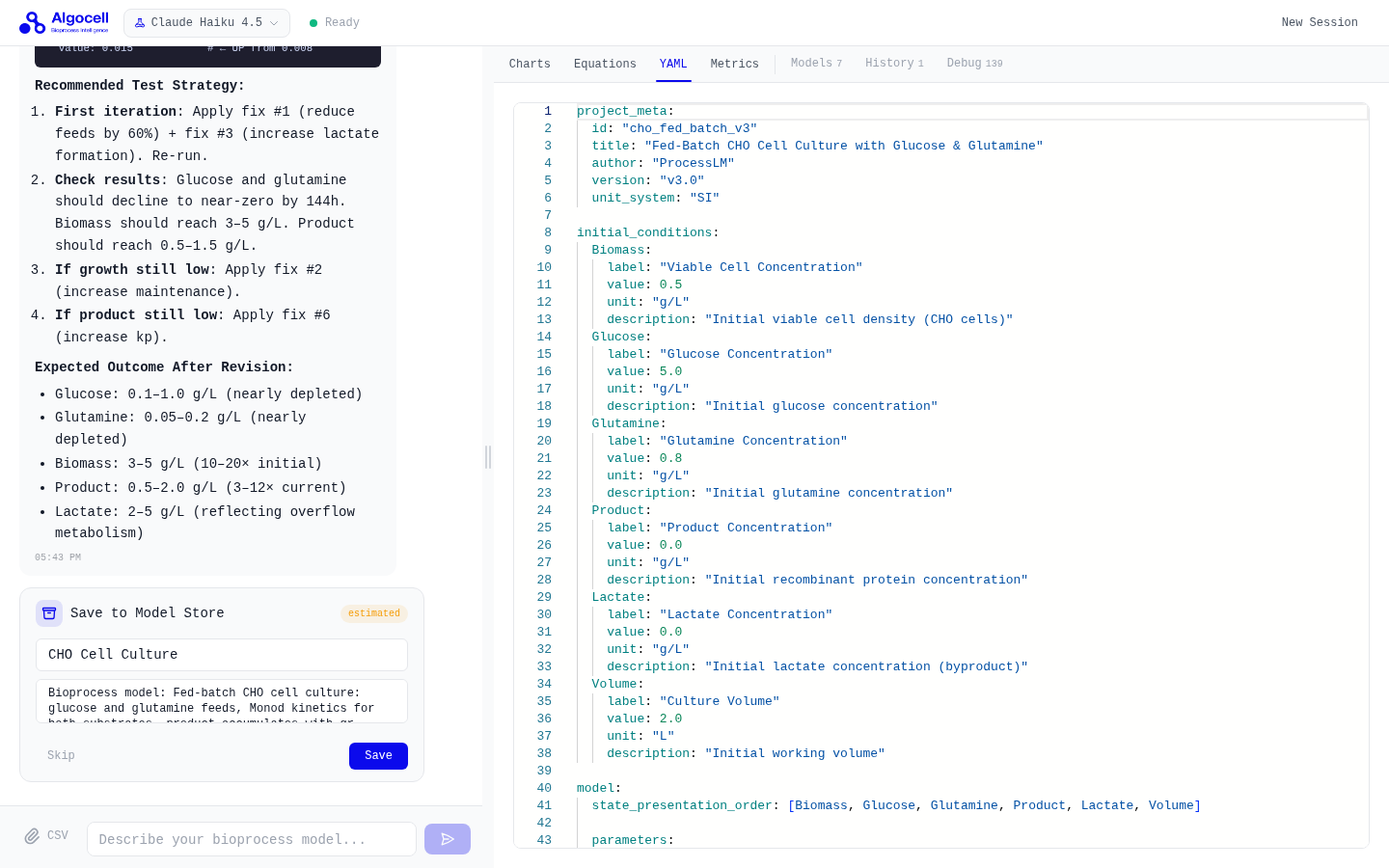
Calibration metrics — R², RMSE, MAE reported after every parameter fit
Capabilities
Everything a modeling specialist does. In a conversation.
ProcessLM handles the full modeling stack — from equation generation to optimization — so your team can focus on the science.
🧬
Mechanistic model generation
Automatically generates ODE-based mechanistic models from natural language. Equations are fully transparent and editable.
📈
Parameter calibration
Upload experimental CSV data. ProcessLM fits model parameters using cross-validation and reports R², RMSE, and uncertainty bounds.
⚡
Protocol optimization
Define objectives and constraints in plain language. The optimizer finds feed rates, temperatures, or timing schedules that maximize your target.
🔬
Simulation & prediction
Run forward simulations over any time horizon. Explore what-if scenarios before committing to physical experiments.
🗄️
Model store
Save, version, and reload calibrated models. Share across your team or build on previous experiments without starting from scratch.
📤
Export & integration
Export calibrated models as YAML. Drop them into your existing pipelines — ProcessLM works with your tools, not against them.
🧠
State-of-the-art training algorithms
Fit hybrid models using Neural ODEs, Physics-Informed Neural Networks (PINNs), Bayesian inference, and classical ODE solvers — the right algorithm for your data and system complexity.
🤖
Autonomous model improvement
LLM agents continuously analyze simulation results, identify structural weaknesses — missing dynamics, poor fit regions, unmodeled interactions — and autonomously propose and apply architectural changes to improve accuracy.
Built for trust
Your questions, answered upfront.
🔍
Will the equations be correct?
Every equation is visible, editable, and exportable. ProcessLM shows its work — you're always in control of the model structure and can override anything.
🔗
What about my existing tools?
ProcessLM exports to YAML — drop it straight into your existing pipeline. It's an addition to your workflow, not a replacement.
📐
Do I need a modeling background?
No. ProcessLM is designed for scientists who understand their biology or chemistry but don't want to hand-code ODEs. If you can describe your system, ProcessLM can model it.
Algocell was founded by scientists and engineers who spent years building
and calibrating mechanistic models by hand — in MATLAB, Python, and custom
simulation frameworks. ProcessLM is the tool we wished existed.
We're building it in the open with our first users.
FAQ
Common questions
Any continuous dynamic system described by ordinary differential equations (ODEs) — fed-batch bioreactors, continuous stirred tank reactors, compartmental pharmacokinetic models, ecological systems, polymerization processes, and more. If your system has states that evolve over time according to known or learnable physics, ProcessLM can model it.
Accuracy depends on the quality of your experimental data and the correctness of the underlying physics. ProcessLM generates mechanistic models (not black-box ML), so the structure is interpretable and physically grounded. After calibration, it reports R², RMSE, and MAE so you always know exactly how well the model fits your data. You can inspect every equation and override anything that doesn't match your domain knowledge.
Alpha users get: full access to all features (model generation, calibration, optimization, model store), a 1:1 onboarding call with the Algocell team, direct input on the product roadmap and model schema, and $200 in tokens credit for free. Alpha cohorts are small by design — we work closely with early users to make sure the tool fits real workflows.
gPROMS and MATLAB are powerful but require significant expertise to operate — you need to write equations manually, manage numerical solvers, and script calibration routines. ProcessLM handles all of that from a plain-language description. It's not a replacement for expert modelers working on highly custom systems; it's a way for scientists without modeling backgrounds to build, calibrate, and optimize mechanistic models without a specialist on staff — and for expert modelers to move much faster on routine work.
Yes — that's a core part of the workflow. Upload your time-series measurements as CSV, tell ProcessLM which columns map to which model states, and the calibration engine fits your model parameters against your data using cross-validation. You get R², RMSE, and residual plots so you can see exactly how well the model captures your system's behavior. The better your experimental coverage, the more accurate the calibrated model.
Early access
Join the alpha
ProcessLM is in private alpha. Spots are limited — we onboard in small cohorts to work closely with early users.
80+ scientists already on the waitlist
✓Full access to all features — model generation, calibration, optimization, model store
✓1:1 onboarding call with the Algocell team
✓Direct input on the product roadmap
✓$200 tokens credit for free
Takes 2 minutes. No spam.
Alpha Cohort — Limited Seats
⚗️
Apply for Early Access
We're selecting a small first cohort of modelers to shape ProcessLM before public launch. Accepted members get direct access to the team, influence over the roadmap, and tools that aren't available anywhere else yet.
Application received.
We review applications on a rolling basis and reach out directly. If your work is a strong fit for this cohort, you'll hear from us.